The body still dumps heat. The suit has to vent it somewhere.
Psychological techno-thrillerRecognition failureNeural interfaceContainment breach
The Chromatic
Protocol
A psychological techno-thriller about an FBI agent who cannot recognize faces, a case built on identity itself, and a neural-interface technology that can rewrite what people see, remember, and believe.
Available now · paperback and Kindle
Perceptual field
Live cover distortion.
Choose a layer; the page rewrites the signal.
Reader response
Early Amazon readers are finding the signal.
Public reader reviews keep circling the same coordinates: a fast pace, a grounded near-future threat, and an FBI analyst whose face blindness changes how the case can be solved.
“A major new voice in the techno-thriller genre.”
“A plausible, near future thriller.”
“A smart technothriller led by an FBI analyst with a unique condition.”
“Makes you think without ever slowing down the action.”
“An excellent, near future techno-thriller.”
“Relentless pacing alongside rare emotional intelligence.”
“Merges high-concept science with deeply human character struggles.”
“A fast-paced and thought-provoking read that delivers plenty of excitement.”
“Couldn’t put it down.”
“One of the better thriller novels I’ve read in a while and I mean that as a fan of the genre.”
“The prose is cinematic, which I absolutely loved.”
Chapter One · first kill
The Footage Warped
Michael Harrison had thirteen minutes left to live, and he was thinking about his wife.
The twentieth floor of the Hoover Building was empty except for Harrison and his case files. Ristorante Luna would have given away their anniversary table by now. Katherine had stopped calling at nine.
The air pressure in the room changed.
It was subtle, a shift you’d feel in your sinuses before you could name it. The hair on his forearms lifted. He smelled ozone, sharp and wrong, threaded with something synthetic, like heated plastic.
Harrison looked up, his primitive brain screaming danger before his conscious mind could process why.
The office door was closed. The hallway beyond the glass partition was empty, lit by the green wash of emergency lighting. Security wouldn’t come for another thirteen minutes.
The security footage, reviewed later, would show Harrison turning in a slow circle. Hands rising, palms out. Mouth shaping a word three forensic lip-readers would independently identify as impossible.
Then the footage warped.
No power surge. No equipment failure. The timestamp ticked forward with normal precision, but Harrison’s image rippled as if viewed through water.
The air around him bent and warped, creating a man-shaped void in space where the light should have been but wasn’t.
His hands flew to his throat. His fingers clawed at empty air that somehow left bruises spreading across his trachea, blooming purple and black.
For readers who want the sharp edge
If you live for cerebral, hard-edged thrillers —
- Perception turned into a weapon, grounded in real physics
- A protagonist whose disability is her sharpest instrument
- Locked-room murders, a buried DARPA program, a killer you never see coming
- A standalone story that opens a series
“It doesn’t just hide you from sight. It teaches other people’s brains to ignore you.”
Free reader briefing
Read the Perception Wars Field Briefing.
An in-universe companion dossier from the world of The Chromatic Protocol: perception warfare, narrative control, detection seams, and the contested future of memory.
Delivered through BookFunnel so you can read in the browser, download the PDF, email it to yourself, or save it to your BookFunnel library.
For book reviewers
Want to review books on Reedsy Discovery?
Reedsy Discovery connects reviewers with new books and pays approved reviewers for their first posted review. If you already review fiction, you can apply through Wesley’s referral link.
Referral disclosure: this is Wesley K. Alexander’s Reedsy affiliate link.
About the book
A psychological techno-thriller about the one sense we trust without noticing.
The Chromatic Protocol opens with Special Agent Sarah Chen studying a family photograph beside her Glock, knowing the people in it by context but not by face.
Her prosopagnosia should be a limitation. Instead, it becomes the one irregularity that lets her see through a system designed to exploit everyone else’s certainty.
The novel moves from Bureau emergency rooms and Berkeley neural-interface research into committees, countermeasures, buyers, patient zero events, and the reflection gallery where perception stops being evidence and becomes terrain.
01Face BlindIdentity without recognition
02The CommitteeInstitutional secrecy under stress
03Patient ZeroTechnology crossing into exposure
04ProliferationOnce seen, it cannot be unseen
Detection stack
Four ways to find what can’t be seen.
Invisibility bends light — but it can’t escape physics. Chen builds the case one spectrum at a time.
Metamaterials tuned to visible light scatter outside it.
A person displaces air and sound, seen or not.
Floors, doors, footsteps — weight always leaves a trace.
Available now
The protocol is live.
“I think this book was pretty darn good. But I also wrote it.”
Buy The Chromatic Protocol on Amazon
Paperback + Kindle available now
The Reflection Gallery
Fragments, not faces.
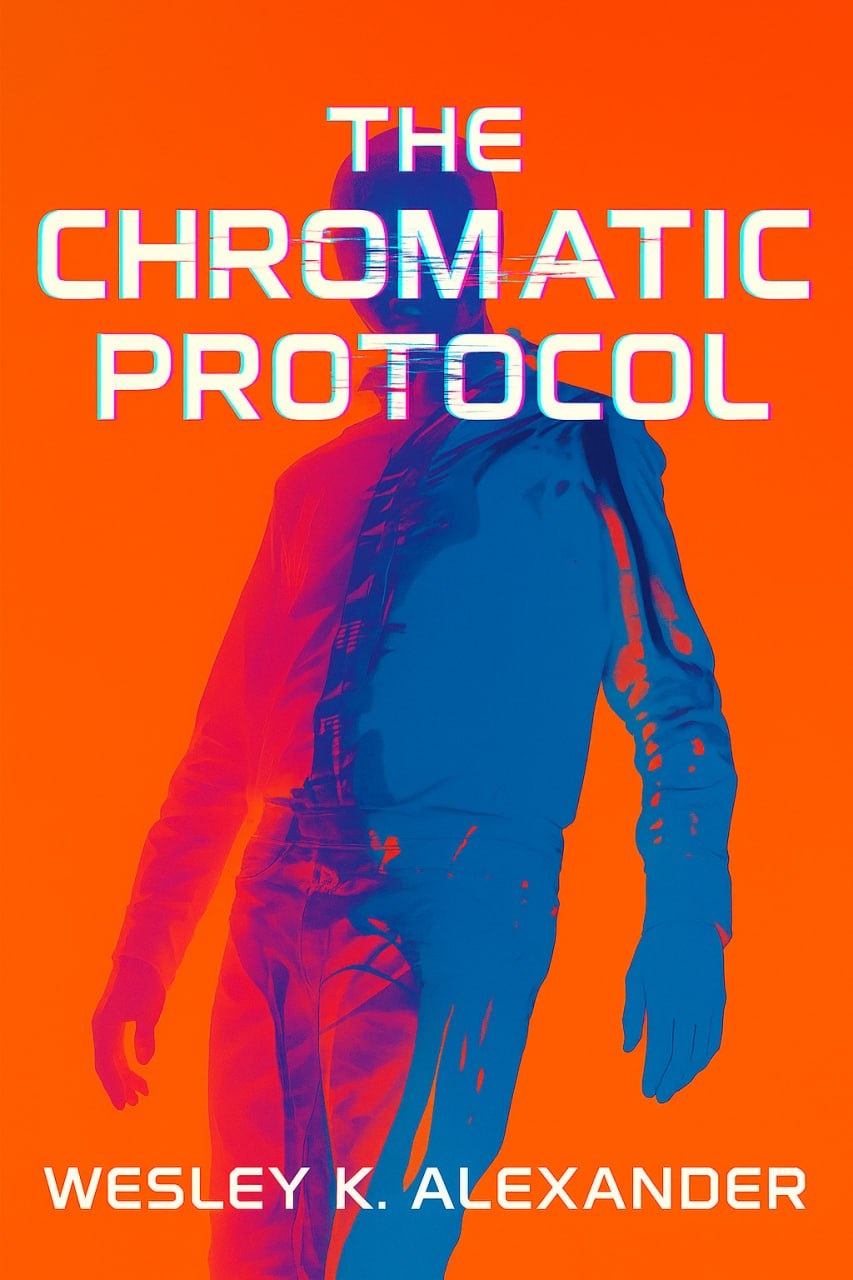
The site’s visual language borrows from the cover: saturated orange pressure, cyan-magenta ghosting, faceless identity, and the uneasy moment when a familiar body becomes evidence you cannot quite assemble.
The first clue is not what happened. It is what everyone insists they saw.
Every protocol creates a shadow protocol. Every safeguard teaches the breach how to move.
Someone always wants the impossible thing after it has been proven possible.
Recognition becomes a moral act when memory itself can be altered.

Reader updates
Get the next signal.
Occasional notes on new releases, reader extras, and what comes next — including first looks at Wake Word, the next book. Start with the free Perception Wars Field Briefing, then stay for the next signal. No drip campaign. No motivational confetti. Civilization endures.